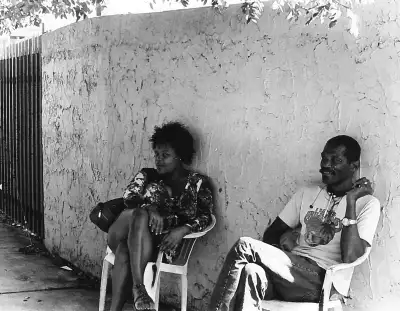
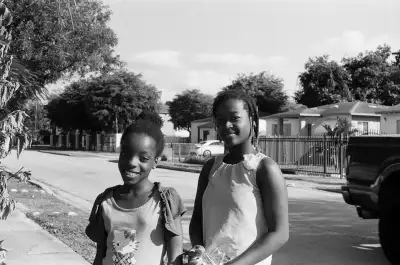
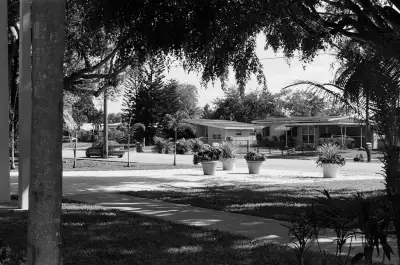
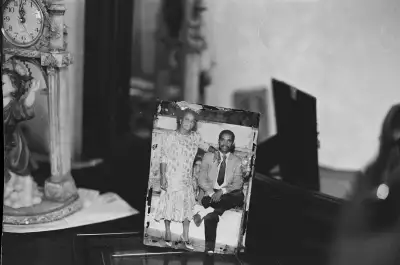
The footage I’ve captured mirrors the imagery I often come across as a Haitian living in Miami: chickens roaming the streets of Little Haiti, the soft movement of waves drifting from Miami’s shores into the Caribbean Sea, and portraits of historical figures from Little Haiti and Haiti itself. These spaces remind me of my connection to home.
The archival material—something I’ve engaged with more intentionally over the past couple of years—has offered me glimpses of the island. It has become a visual language through which I’ve been able to imagine and understand Ayiti, even from afar. Together, these videos reflect a convergence: of past and present, of memory and imagination, of the seen and the unseen. It represents the enduring connection between Haiti and Miami—how one informs, shapes, and mirrors the other.
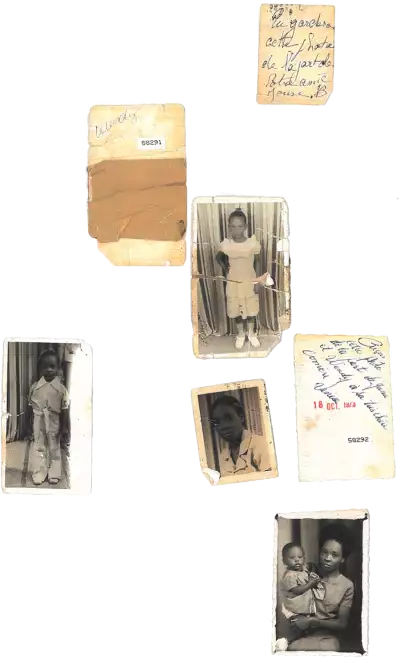
Within my work, I often return to the people, places, and stories that have shaped my understanding of Haiti. This return is intentional—a dissection of the textures of home: how it is built, remembered, mourned, and reimagined.
I was seven years old when my father first took me to the home once owned by my great-aunt in Little Haiti. Now a familial landmark, it’s come to symbolize the passage of both known and unknown relatives who have made their own version of the Great Migration from Haiti to Miami during the 1980s, a decade that radically transformed the city’s cultural landscape. The duality of this journey has never been lost on me. It holds both a history of endings and beginnings—an exodus marked by rupture and renewal, where the gap between the diaspora and home quietly exists.
Within my work, I often return to the people, places, and stories that have shaped my understanding of Haiti. This return is intentional—a dissection of the textures of home: how it is built, remembered, mourned, and reimagined. My practice carries an inherent understanding of the homeplace as a site of resistance (bell hooks). The spaces I choose to document, these evocations of home, are where I’ve been extended a sense of care that has grounded and shaped my identity as a daughter of the diaspora.
As Nou Ayiti invites us to question and reconsider our vision of the future of Haiti, it leads me here: to a future in which our compass points us back home, to Ayiti, where the fragments of our past, present, and futures are gathered to imagine new geographies of care. A return to home in which, across the diaspora, we can all find refuge and repose. We must come to understand the role of our beloved Haiti, no matter how fragile and tenuous, as vital in helping us regain wholeness. Only then can we begin to rethink our relationship to placemaking and fuel the kinds of imaginaries needed to build transformative futures.
Home is not a fixed point, but a place of return. Lespwa fè viv.
Tabitha Cherubin (b. 2000, Miami, Florida; lives in Miami, Florida) is an artist born and based in Miami, Florida, whose work spans the mediums of painting, photography, and film. Rooted in personal memory as well as cultural and familial inheritance, her practice explores how diasporic identity moves beyond nostalgia to imagine new futures. She often considers her work as a visual process of self-exploration, engaging with concepts of placemaking, the oppositional gaze, and relation while drawing on the rich cultural intersections that define Miami. Cherubin earned a BFA in Visual Art Studies and Sociology from the University of Florida. Her work was most recently exhibited in Intracoastal Connections at Oolite Arts (2023) and featured in Coming of Age in 2020, published by New York Times editor Katherine Schulten (2022). She has previously worked with institutions such as Pérez Art Museum Miami, The Bass Museum of Art, and Mindy Solomon Gallery, before most recently shifting focus to her studio practice.