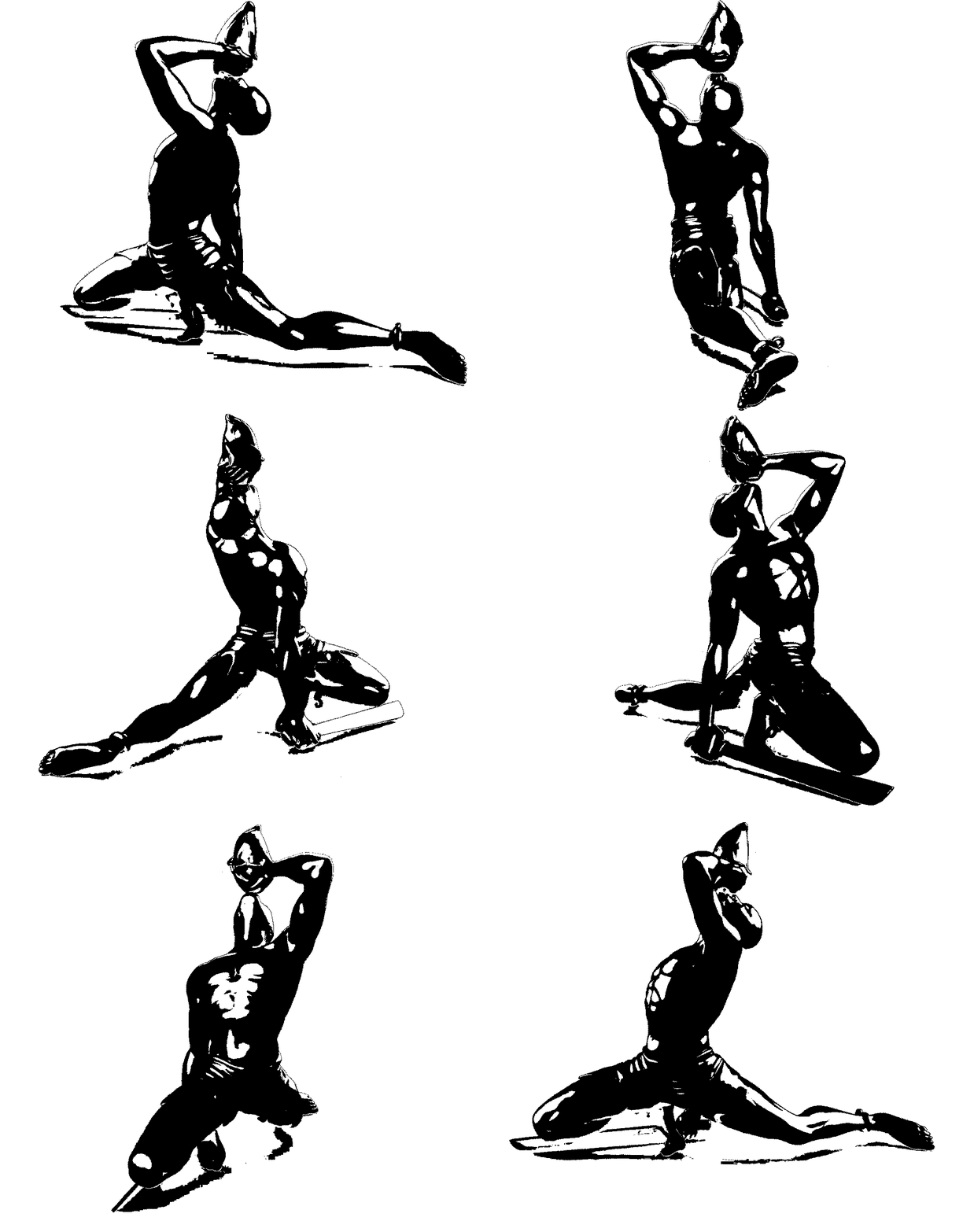
Staring Contest (Study)
EMMANUEL MASSILON, Staring Contest (Study), Wood, pigment, metal nails, metal screws, and glue, 2021, 39 × 11 × 8 in
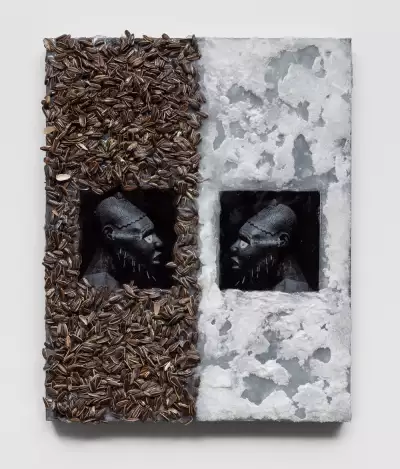
Growing up in Washington, D.C., I was raised in a food desert—a place where access to fresh, nutritious food was scarce, but corner stores and ice cream trucks were everywhere. One of the most popular snacks in my neighborhood was sunflower seeds. They weren’t just a treat; for many of us, they were breakfast. What kept us coming back wasn’t the seeds themselves, but the sodium. The salt content was addictive. I watched kids crave it so much, they’d eat sunflower seeds before even thinking about a real meal. That routine—shaped by a lack of access to places like Whole Foods—deeply influenced how we understood hunger, nutrition, and care.
In my sunflower seed paintings, I reflect on these early experiences while weaving in the spiritual and cultural legacy of the African diaspora. I collage together African figures drawn from various tribes and traditions, each representing the enduring spirit, beauty, and diversity of Black identity. Their colors, sizes, and patterns speak to the richness and complexity within Black culture—both historically and today.
By placing these figures in conversation with sunflower seeds and the symbolism of sodium, I aim to examine how systemic issues like food deserts and poor nutrition have shaped the Black American diet—often leading to conditions like heart disease and high blood pressure. These works become visual conversations about survival, consumption, health, and cultural inheritance.
As an artist, I resist traditional aesthetics and embrace experimental materials. I want the viewer to pause and wonder: is this a painting, or something else? That moment of uncertainty is intentional—it invites deeper engagement, a closer look, and a willingness to question what lies beneath the surface.
This body of work is a call to reflect on how our environments shape our habits, our health, and our collective well-being—and how food access, or the lack of it, continues to impact Black communities across the U.S.
Mud Libation (RIP Fredo Santana)
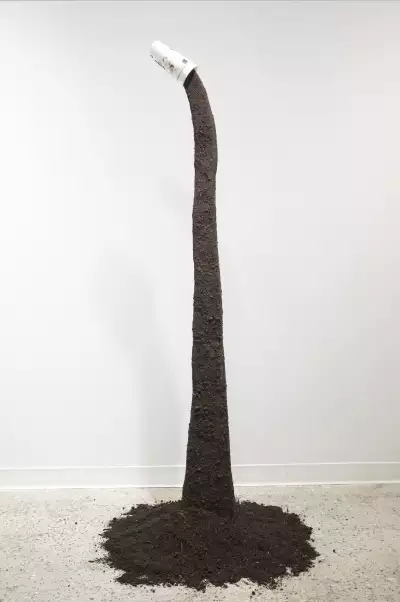
EMMANUEL MASSILON, Mud Libation (RIP Fredo Santana), 2020, Dirt, wood, metal on styrofoam, 74 × 18 × 20 in
Lean, sometimes referred to as “mud” and known by several other names in inner-city communities, is a recreational drug made by mixing prescription cough syrup with a soft drink. The term “mud” refers to the heavy amount of cough syrup used, creating a dark, thick consistency resembling actual mud.
In African traditions, the act of giving libations involves offering spiritual gifts to gods and ancestors in honor of lost leaders, family, and friends. This ritual dates back to Ancient Egypt and is deeply rooted in African diasporic religions, including those practiced in Haiti and across the continent.
In this piece, I wanted to merge both concepts—street culture and ancestral ritual—into a single work. The double-stacked Styrofoam cups appear to pour out mud, suspended mid-air, creating the illusion of a libation in progress. This visual pun invites all viewers into the work, even if they may not immediately recognize the slang or cultural references.
Many rappers use the word “mud” in lyrics to reference or glorify the act of drinking lean. I wanted to use both literary and visual puns to enter that conversation—to document street culture, critique it, and record its history. This piece is dedicated to one of my favorite rappers, Fredo Santana, who died of an epileptic seizure caused by long-term opioid use. Through Mud Libation, I hope to raise awareness about the growing opioid crisis in the United States—particularly its devastating impact on inner-city communities.
Double Consciousness
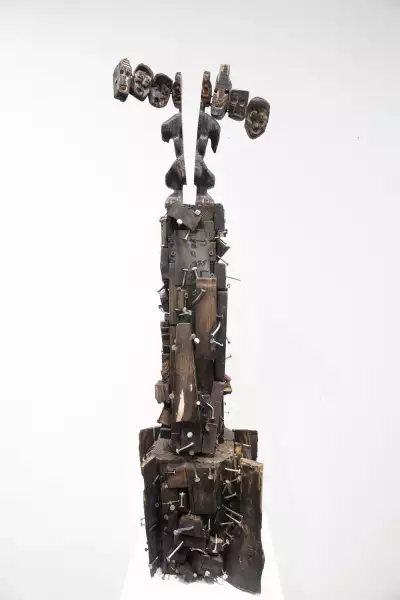
EMMANUEL MASSILON, Double Consciousness, 2021, Wood, pigment, metal nails, metal screws, and glue, 39 × 11 × 8 in
Double Consciousness refers to the internal conflict experienced by oppressed or colonized groups within a dominant society. The term was first introduced by W. E. B. Du Bois in his seminal 1903 text The Souls of Black Folk, where he described the African American experience of constantly seeing oneself through the lens of a racist white society—measuring one's worth against a system that views Blackness with contempt. Du Bois also used the term to describe the tension between his African heritage and his upbringing in a European-dominated culture.
In this piece, I chose to hand-carve a wooden figure and split it in half to represent the fractured spirit of Blackness in America—the ways in which Black individuals are often forced to navigate multiple, conflicting realities. Attached to the body are floating heads, each representing a different mask or identity that Black people may adopt in order to conform to societal expectations rooted in whiteness. These heads are meant to convey the psychological flexibility—almost a kind of magic—required to move between identities as a means of survival.
The figure stands on a pillar to symbolize how the idea of double consciousness is not only foundational to the Black experience in America, but also elevated within Black culture as a necessary and resilient strategy of everyday life.
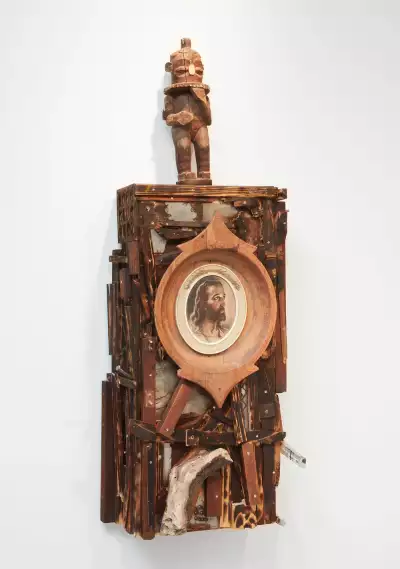
Contemplating Existence
EMMANUEL MASSILON, Contemplating Existence, 2023, Wood, metal, pigment, picture frame & jet ink print, 73.5 × 24.5 × 14.5 in
In my art practice, I explore the collision and convergence of traditional European aesthetics and African spiritual traditions. Growing up Christian while also being exposed to African spirituality, I became deeply interested in how these belief systems overlap, conflict, and give rise to new identities. Much of my work opens conversations around Black religion, colonialism, and the survival of culture through forced transformation.
Christianity was brought to Africa largely through violence—via slavery and colonialism—often replacing indigenous belief systems. But rather than disappearing, these spiritual traditions evolved. New forms of expression emerged, blending African ritual practices with Christian iconography. I investigate how these tensions continue to shape the visual and spiritual language of the African diaspora today.
In 2023, I created Contemplating Existence, a sculptural work that brings these histories into focus. The piece features a West African totem set beside a printed image of a white Jesus, nailed into a patchwork wooden structure. Elevated high on the wall, the sculpture confronts the viewer with a visual tension between spiritual traditions and colonial imposition. The central figure appears deep in thought, suspended midair—a reference to how Black people have historically been held in suspension, both spiritually and physically, often through violence. The piece embodies a state of forced contemplation and survival within systems designed to oppress.
My practice draws from the language of hip hop, using sampling as a conceptual framework. I fuse African aesthetics, European painting traditions, Black Southern culture, and Haitian sculptural techniques. Found objects and salvaged wood, assembled into abstract forms, have become signatures of my style—symbols of resilience and the reimagining of cultural histories.
Contemplating Existence asks viewers to reflect on the legacy of religious colonialism and the complicated spiritual paths that have emerged from it.
My work explores themes of identity, resilience, community, and transformation—often through the use of found materials, woodcarving, and visual references to African and diasporic histories. My artistic practice is deeply aligned with the spirit of Nou Ayiti—a vision of a renewed, self-determined Haiti—because it centers on reclaiming narratives, preserving cultural memory, and building strength from within communities that have long been marginalized.
Through sculpture, performance, and installation, I aim to honor the past while creating space for future possibilities. My patchwork wood structures, for example, draw from Haitian traditions of craftsmanship, survival, and spirituality. They reflect the idea that beauty, meaning, and power can emerge from fractured or humble materials—much like Haiti’s revolutionary legacy and its ongoing fight for self-definition.
Looking ahead, I hope to bring my practice directly to Haiti, collaborating with local artists, youth, and craftspeople on community-based public art projects. Through sculpture-making, storytelling, and cultural exchange, I believe art can be a healing force—sparking dialogue, cultivating pride, and building solidarity. My vision aligns with Nou Ayiti in using art not only as a form of personal expression but also as a tool for collective empowerment, resilience, and reimagining a liberated future for Haiti.
Emmanuel Massillon (b. 1998, Washington, D.C.; lives in Baltimore, Maryland) is a conceptual artist whose multidisciplinary practice spans painting, performance, sound, and sculpture. His work critically examines race, identity, and culture, particularly as they relate to people of African descent. Growing up in Washington D.C.’s inner city, Massillon’s experiences shape his artistic lens, challenging conventional narratives and offering fresh perspectives on everyday life and politically charged subjects. His work serves as both a critique and a celebration—interrogating power structures while amplifying the resilience, ingenuity, and creativity found within marginalized communities.
Massillon has exhibited internationally, with museum exhibitions in France, Italy, and China. His work is held in the permanent collections of the Baltimore Museum of Art, C21 Museum, The Flint Institute of Arts and Virginia Museum of Fine Arts. Through his evolving practice, he continues to push the boundaries of conceptual art, bridging personal and collective histories while redefining how Black culture is represented and preserved in contemporary art spaces.